
Whole-house water filtration for every tap
One filtration system at the main line means clean water at every faucet, shower and appliance — no per-fixture filters to forget. Packages start at $1,885 installed (a reference price until CreekWell’s contractor licenses are issued), sized from your water numbers — the free water check on city water, a $185 lab test on a well, and SimpleLab’s separate $334 test for PFAS — so you only pay for the stages your water actually needs.
What a whole-house filter does
A whole-house (also called “point-of-entry”) filter installs at the main water line just inside your home. Every drop of water that enters the house passes through it before reaching any tap, shower, dishwasher or water heater. That’s the difference from an under-sink or refrigerator filter, which only treats one fixture.
A whole-house system is built in stages chosen from your water test: a sediment filter to catch sand and silt from the main or the well, a carbon stage for chlorine, taste and odor, and — when your test calls for it — a stage for iron, manganese, arsenic or PFAS (the “forever chemicals”). Each package below is one of those stages, or a set of them. Stages are modular: you add or remove them as your water changes. Every other option, compared: water treatment in Prescott.
What a filter does not do is soften. Dissolved hardness takes a water softener, and drinking-water purity at one tap is a job for under-sink reverse osmosis.
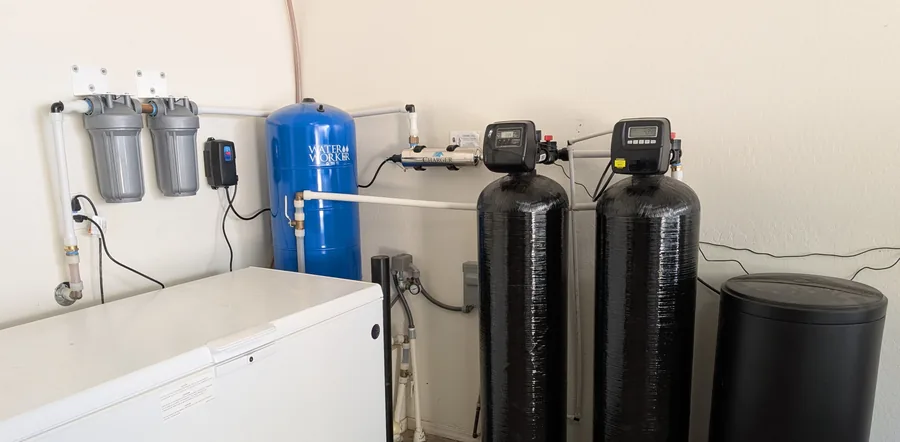
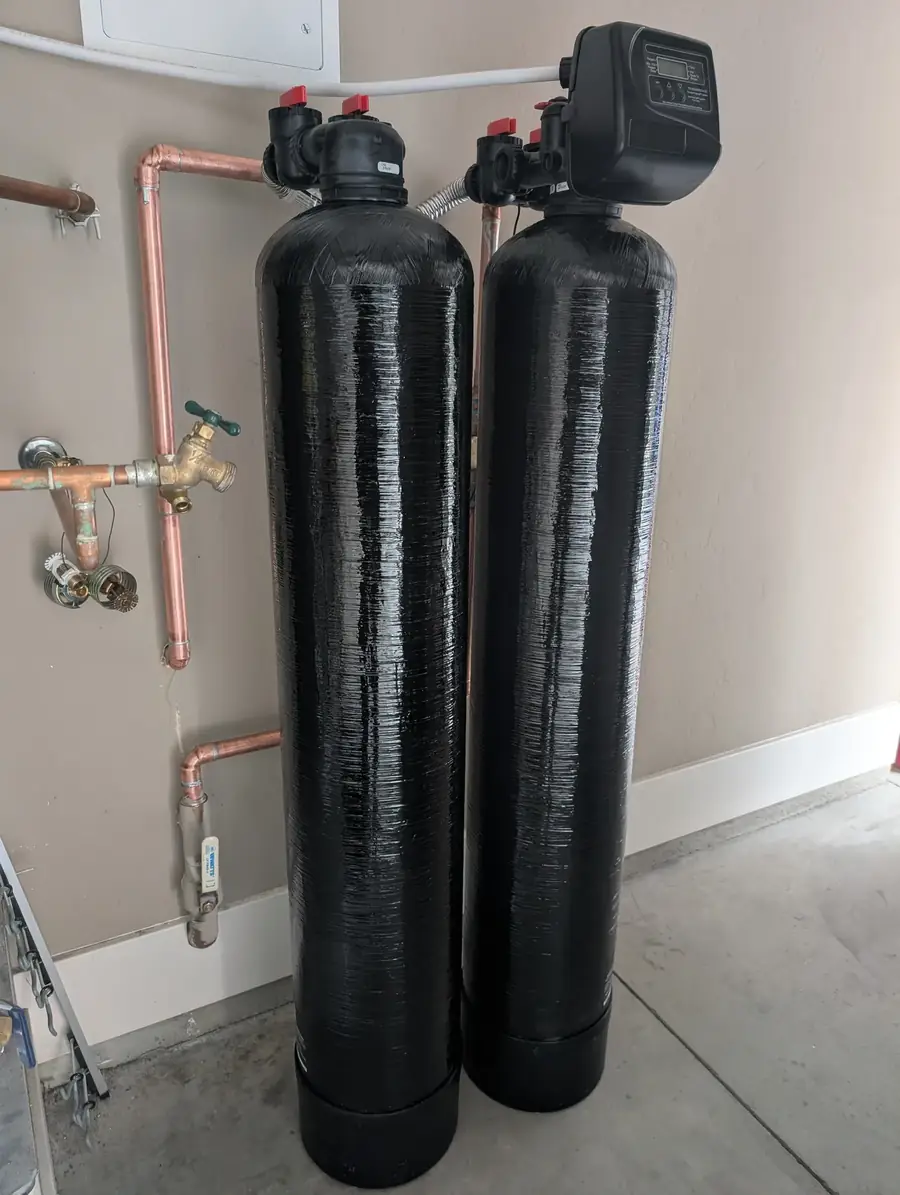
What a whole-house system costs — same price countywide
Whole-house filtration is flat-rate priced — $1,885 to $4,750 installed for the five filtration packages — depending on what you are taking out of the water. Find your problem in the left-hand column:
| Your water problem | Package | Installed |
|---|---|---|
| Chlorine or chloramine taste and smell, on city water | The Lynx Package: catalytic carbon on a Clack WS1 valve — spec sheet | $1,885 |
| Sand, silt or grit, plus hardness, on a well | The Sand Cat Package: sediment filter and water softener — spec sheet | $3,075 |
| Rusty stains or a rotten-egg smell, plus hardness, on a well | The Panther Package: iron/sulfur filter and water softener — spec sheet | $3,400 |
| PFAS | The Caracal Package: PFAS cartridge and catalytic carbon tank — PFAS removal · spec sheet | $3,450 |
| Arsenic, on a well | The Jaguar Package: arsenic media suited to your water by a lab test — arsenic removal · spec sheet | $4,750 |
Not bookable yet. This work comes to $1,000 or more, so it waits for CreekWell’s contractor licenses.
Why not yet?
Until its Arizona contractor licenses are issued, CreekWell takes only jobs that come to under $1,000 in all and need no permit and no gas. The price is published so you can plan and compare; it is not an offer, a quote or a bid. What the licenses change
Included in every package: the plumbing, installation and testing, with CreekWell’s two-year workmanship warranty plus the maker’s or the supplier’s warranty on the parts (each spec sheet lists it by part). Packages install on your existing loop — the pair of pipes a builder leaves for water treatment. If your house needs loop plumbing, or existing plumbing needs to be brought up to code, you are shown what is needed and given a written price for it first. The Lynx is the Aqua Cat Series catalytic carbon whole-house filter on a Clack WS1 valve; the supplier lists two catalytic carbon grades, Centaur and Clack’s CAT-HAC, and yours is written on your estimate.
Two more for wells. The Serval Package, ultraviolet disinfection for a well that tests safe today (not NSF/ANSI 55 certified), goes last, after any filters (spec sheet), is $1,875. The Cougar Package — sediment filter, iron filter, softener and UV as one complete well system — is $6,475. See private well water treatment.
Whole-home reverse osmosis is a separate category at $14,999.99 flat countywide, covered on the whole-home reverse osmosis page.
The same flat rates apply everywhere in Yavapai County — Prescott, Prescott Valley, Chino Valley, Dewey-Humboldt, Mayer, Paulden, Sedona, Cottonwood, the Verde Valley and the outer county. They are not Prescott-only rates.
When you need whole-house vs. Under-sink
Choose whole-house filtration when:
- You want clean water at every shower, sink, dishwasher and ice maker.
- You’re fighting chlorine taste, hardness scale, or sediment that’s damaging fixtures.
- You’re on a private well with iron, manganese or arsenic above EPA levels.
Choose under-sink filtration, or reverse osmosis, when:
- Your only concern is drinking and cooking water — its taste, or a specific contaminant.
- Budget is tight: under-sink RO is $829–$999 installed, against $1,885–$4,750 for whole-house.
Plenty of Prescott homes — especially those on private wells — end up with both: whole-house for everyday use, under-sink RO for drinking. Neil sizes the combination from your $185 Premium Water Test.
How long filters last, and what upkeep costs
What wears out, and when, depends on the package and on what is in your water. From each package’s spec sheet:
| Package | What wears out | When it is replaced |
|---|---|---|
| The Lynx | Catalytic carbon | No fixed published life. Clack: when it can no longer reduce chloramine or hydrogen sulfide; Neil tests for chlorine getting through |
| The Caracal | Pentair PFAS cartridge | About every 12 months or 40,000 gallons, sooner if the flow drops (Pentair) |
| The Jaguar | Arsenic media; sediment pre-filter | Media when treated-water tests show arsenic coming through — 2–4 years in AdEdge’s example, 1–3 in New Hampshire’s guidance; pre-filter every 3 months (AdEdge) |
| The Panther | Iron-filter media | No fixed published life; when iron starts coming through |
| The Sand Cat | Sediment cartridge or screen | When the water pressure drops or it looks loaded |
Replacement parts that are not on the published price list are priced on your written estimate, and each spec sheet works out the running costs it can — the Jaguar’s, for example, adds up its lab tests and media. Your written estimate sets the maintenance schedule for your install. A clogged cartridge is also the usual reason for a drop in water pressure.
Service areas
Once its contractor licenses are issued, CreekWell will install whole-house water filtration across all of Yavapai County: Prescott, Prescott Valley, Chino Valley, Dewey-Humboldt, Sedona, Cottonwood, Cornville, Camp Verde, Clarkdale, Jerome, Mayer, Paulden, Kirkland, Yarnell and Congress, Bagdad, Seligman and Ash Fork, and Black Canyon City.
Related: water softener installation, salt-free water conditioners, the Navien WEC600, reverse osmosis, well water treatment and water testing.
Questions people ask Neil
Can you come out right now?
Yes, for repairs and emergencies under $1,000.
Call or text 928-228-5770, Monday to Saturday, 7am to 7pm; a priority call gets a same-day visit when Neil is free. Whole-house systems wait for the contractor licenses (what the licenses change).
How much does a whole-house water filter cost in Prescott?
From $1,885 installed for The Lynx Package, catalytic carbon for chlorine taste and smell on city water — a reference price until CreekWell’s contractor licenses are issued.
Sediment or iron packages with a softener run $3,075–$3,400 (The Sand Cat Package, The Panther Package), PFAS removal is $3,450 (The Caracal Package) and arsenic removal $4,750 (The Jaguar Package). Whole-home reverse osmosis is a separate category at $14,999.99 flat. Each package’s spec sheet gives its upkeep and the running costs it can.
What does a whole-house filter remove?
It depends on the stages you install.
A whole-house system removes what its stages are chosen for: sediment (sand, silt, rust), chlorine taste and smell, and, depending on the stage, iron, manganese, arsenic, PFAS or sulfur. Whole-house filters do not remove dissolved hardness — that takes a water softener — and do not produce drinking-water-purity output the way under-sink reverse osmosis does.
How long do whole-house filter cartridges last?
It depends on the package and your water; each spec sheet gives its own figure.
The Caracal’s Pentair PFAS cartridge is rated about 12 months or 40,000 gallons (Pentair). The Jaguar’s arsenic media lasts about 2–4 years in AdEdge’s example and 1–3 in New Hampshire’s guidance. The Lynx’s catalytic carbon and the Panther’s iron media have no fixed published life and are replaced when a test shows they have stopped working, and a sediment cartridge is changed when the pressure drops or it looks loaded. Your written estimate sets the maintenance schedule for your install.
Will a whole-house filter reduce my water pressure?
Some.
The parts the makers rate lose a few psi or less at everyday flows; the supplier publishes no figure for its tanks.
Clack’s valve, on the Lynx: about 0.5 psi at 5 gallons a minute and 2 at 10 (our arithmetic from Clack’s flow rating, Cv 7.0), and 15 psi at its full 27 gallons a minute. Pentair’s PFAS cartridge, on the Caracal: 3 psi at 5 gallons a minute, rising to 7 at 10. Undersized or clogged filters are what cause noticeable pressure loss. Neil measures your home’s flow and pressure before specifying a system and sizes it to them. The Caracal’s PFAS certification was tested at 5 gallons a minute, and its spec sheet explains what that means for a busy household.
Whole-house filter vs. water softener — do I need both?
They solve different problems, and many Prescott homes need both.
A water softener removes hardness (calcium and magnesium) — the cause of scale and soap scum. A whole-house filter takes out other things, depending on what is in it: sediment, chlorine taste and smell, iron, and, with the right package, arsenic or PFAS. Where both are needed they go in series, because water here is often hard and carrying something else.
Can I install a whole-house filter myself?
Some homeowners do, but it is main-line work.
In Arizona, any work on the main shut-off and pressure-bearing connections benefits from an experienced plumber, to avoid leaks and code issues. Once CreekWell’s contractor licenses are issued, the Lynx or the Caracal takes about 2–3 hours to install (Neil’s estimate), and a well package’s time is on its estimate: the bypass valves set correctly, the connections pressure-tested, and a two-year workmanship warranty plus the maker’s or the supplier’s warranty on the parts.
Where can I get a whole-house water filter installed near me?
Once its contractor licenses are issued, CreekWell will install whole-house filtration throughout Prescott, Prescott Valley, Chino Valley, Dewey-Humboldt, Mayer, Paulden, Sedona, Cottonwood and the rest of Yavapai County.
Because the right media depends entirely on what is actually in your water, every system is sized from your numbers: the Lynx from the free water check (it includes chlorine), the well packages from the $185 certified lab test, and PFAS from SimpleLab’s separate $334 PFAS test, because PFAS is not on the $185 panel. Sediment and chlorine need very different media than iron, arsenic or PFAS. Most whole-house installs finish in a single visit. If your water is also hard (much of Yavapai County is), a filter alone will not stop scale — you will want it paired with a water softener.
Join the list for when the licenses are issued
Whole-house systems and other work of $1,000 or more wait until CreekWell’s contractor licenses are issued. Both license applications are with the Arizona Registrar of Contractors. Once the licenses are issued, Neil calls the list in the order it came in. Joining needs no deposit. Repairs under $1,000 that need no permit can be booked now.