Aqua Cat is now CreekWell. Aqua Cat’s old number, 480-228-8282, still reaches Neil. Booking repairs and emergencies under $1,000 now. Whole-house systems wait for the contractor licenses. Request a visit

Reverse osmosis

Under-sink reverse osmosis, installed from $829

Drinking and cooking water at one tap, without the scale problem a whole-house system is meant to solve. Flat rate, faucet hole included (on the Kitten and the Ocelot, drilling granite, quartz or stainless is $50 more), no trip fee in Yavapai County.

Our work

Installs we have done

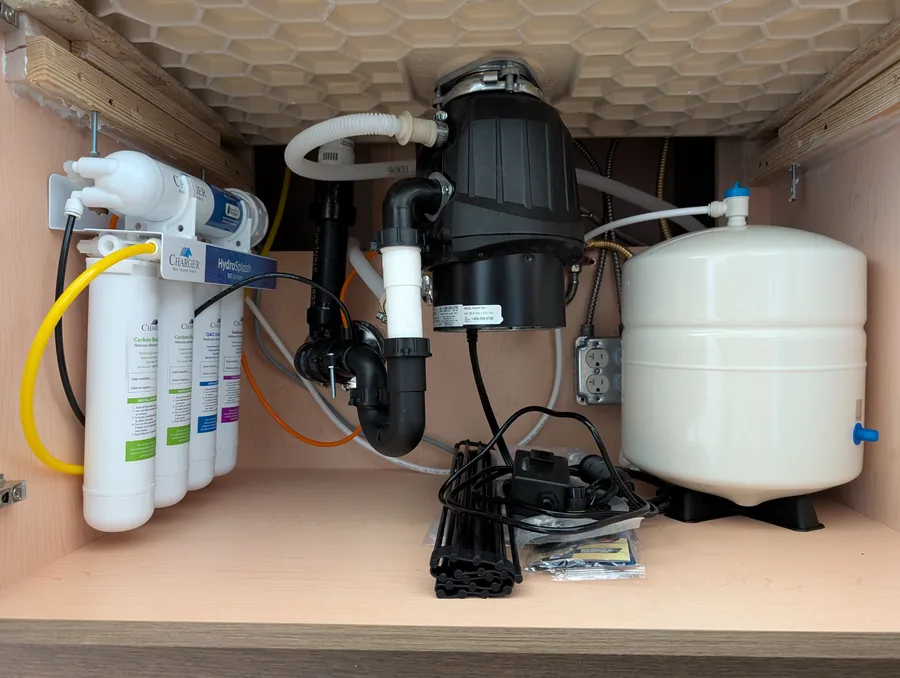
Three CreekWell installs, photographed on the job.

What it costs

Two flat prices, and what they include.

CreekWell installs the ChargerPro HydroSplash reverse osmosis system, sold by Charger Water Treatment Products of Morton Grove, Illinois, with twist-off cartridges you can change by hand in about a minute. Flat installed pricing: what is included is listed below, and anything extra is priced in writing before any work starts.

Now: both can be booked on city water. On a well, the $185 lab test comes first, and Neil tells you from the report whether it can go in now. An Ocelot on a granite, quartz or stainless counter that needs a new faucet hole waits for the licenses.

The limits on a well

Iron up to 0.3 ppm, manganese up to 0.1 ppm and arsenic V up to 300 ppb (Charger’s rating). Above those, the treatment that goes ahead of the RO is whole-house work, which waits for the licenses. The job also has to need no permit.

The Kitten — 5-stage RO

Bottled-water taste at the kitchen sink. Four twist-off sediment and carbon modules and a 75 GPD membrane — the Charger HydroSplash, model HS75. The standard build, and the right one for most homes.

  • Sediment and carbon prefiltration protect the membrane from chlorine, and clean up taste and odor on the way.
  • Quick-connect o-ring fittings: a filter change takes about a minute, by hand, with no tools.
  • Compact: the filter unit mounts on the cabinet wall, with the tank beside it.
$829Installed, flat rate

The Ocelot — 6-stage alkaline RO

The RO water people describe as “smooth.” The same system with an alkaline cartridge after the membrane (Charger’s alkaline conversion kit). Charger says it returns minerals to the water; it does not publish the cartridge’s media or how much it raises the pH. If you find RO water tastes flat, this is the one to choose.

  • Everything the Kitten does, plus alkaline remineralization.
  • An alkaline cartridge after the membrane (Charger’s alkaline conversion kit).
  • The same twist-off cartridges, plus the inline alkaline one, and the same 75 GPD capacity.
$999Installed, flat rate

Both include the system, the install, the dedicated faucet and a faucet hole if there is no spare one. Drilling granite, quartz or stainless is a $50 line: with it the Kitten is $879, still under $1,000, but the Ocelot is $1,049, so an Ocelot on a granite, quartz or stainless counter with no spare hole waits until CreekWell’s contractor licenses are issued — see the licensing note. The $1,000 limit is on the whole job: a code update, a pressure regulator or a fridge line on the same visit counts toward it, and if the total reaches $1,000 the job waits for the licenses.

What’s in your flat install

  • Equipment: the RO manifold assembly, drinking-water storage tank, dedicated faucet, a John Guest angle-stop feed valve (Charger’s invoice), drain saddle, tubing and connectors, the membrane module and the sediment and carbon modules.
  • Labor: installation, a start-up flush, and an on-the-spot TDS reading so you see the number drop.
  • Warranty: the two-year workmanship warranty, plus Charger’s two-year limited warranty on the system.

The flat rate covers most installs where the existing plumbing is up to code. If it needs to be brought up to code, Neil shows you what is needed and puts the price in writing first; if that takes the whole job to $1,000 or more, it waits for the licenses. Any new runs are copper or PEX-A.

Moen

Moen reverse osmosis, with the Sip faucet

For a kitchen where the drinking-water faucet should match a Moen faucet, CreekWell supplies and installs the Moen F9900 under-sink reverse osmosis system with the Moen Sip F7600 cold-water dispenser faucet.

Moen F9900 + Sip faucet

  • Four stages: a sediment filter (F9910), a carbon pre-filter (F9920), the RO membrane (F9930) and a carbon post-filter (F9940), with a 3.2-gallon tank
  • 27.5 gallons a day by Moen’s spec sheet. No outlet needed: Moen’s documents show no pump or power connection
  • The Sip faucet in Bronzed Gold (F7600BZG), the current model with the air gap built in; another finish is priced on your estimate
  • Installation, a faucet hole if needed on any counter (granite and quartz included), a flush and a check
$1,187Supplied and installed · reference price

Before you choose it

  • It waits for the licenses. At $1,187 it is over the $1,000 handyman limit, so it is installed once CreekWell’s contractor licenses are issued. The Kitten, $829, can be booked now if your water is inside its limits and the job needs no permit.
  • Water it can take: 40–100 psi, 40–100°F, cold water only — and not water that may carry germs, or whose quality is unknown, unless it is disinfected first (Moen’s install guide). On a well, the lab test comes first.
  • Filters: the first two every 6 months, the membrane and post-filter every 12 (Moen’s install guide; Moen’s support pages give the membrane 1 to 3 years by water quality). Moen lists them at $69.65 (F9910), $69.65 (F9920), $161.55 (F9930) and $80.75 (F9940) on moen.com (3 October 2026).
  • Certification: Moen says the F9900 with its four filters is certified by IAPMO R&T to NSF/ANSI 42, 53, 58, 372 and 401 (its install guide).
  • Warranty: Moen’s lifetime limited warranty on the F9900 against leaks, drips and finish defects, to the original homeowner (its spec sheet). Moen does not pay for labor (Moen’s warranty terms). For the Sip faucet, Moen’s spec sheet says 3 years and its install guide lifetime; your estimate states which applies. Plus the two-year workmanship warranty on the installation. To claim: call Neil first, 928-228-5770; Moen asks for the original sales receipt with any claim (Moen’s warranty terms).
  • Its life: Moen says the system must be replaced every ten years from installation (its install guide).

CreekWell is independent: it is not affiliated with, authorized by or endorsed by Moen. Moen is a trademark of its owner.

Moen or Kitten?

  • Now: the Kitten, yes ($829, if your water is inside its limits and the job needs no permit); the Moen waits for the licenses ($1,187).
  • Certification: Moen says the F9900 is certified to NSF/ANSI 58 (by IAPMO R&T); CreekWell found no listing for the Kitten’s HydroSplash in NSF’s database (checked September 2026).
  • Code: EPA says the two main model plumbing codes require under-sink RO to be certified to NSF/ANSI 58, and the City of Prescott has adopted the 2024 International Plumbing Code. The Kitten is booked only for a job that needs no permit; if yours turns out to need one, you are told before any work starts and it waits for the licenses. Where an inspector holds an install to NSF/ANSI 58, the Moen is the one that qualifies.
  • Warranty on the unit: Moen’s lifetime limited warranty (leaks, drips, finish); Charger’s 2 years on the Kitten.
  • Output: 27.5 gallons a day is Moen’s figure for the whole system; the Kitten’s 75 is its membrane’s rating, so they do not compare directly.
  • Filters: the Kitten’s filter set is $100, mailed to you, plus a membrane about every 3 years; Moen lists its four at $69.65, $69.65, $161.55 and $80.75 (moen.com, 3 October 2026), about $521 a year on its install guide’s schedule (our arithmetic). Neither system needs electricity.
Install-only

Bought your own RO? We install it.

Bought an under-sink reverse osmosis system online — a Waterdrop G3P800 or another brand, tank or tankless? CreekWell installs it for $499 flat.

When it can be booked. Now: yes, if your system cost $500 or less and the job needs no permit. Cost more? It waits for the contractor licenses — a Waterdrop G3P800 at $849 (Waterdrop’s own store, 3 October 2026) plus $499 is $1,348. Why: Arizona’s $1,000 limit is on the whole job, and CreekWell counts the system you bought toward it; anything added to the visit, a new fridge line for example, counts too. If a job turns out to need a permit, you are told before any work starts.

What the $499 covers

  • The unit and any tank mounted, the feed valve and the drain connection
  • Its faucet, with a new faucet hole if needed, on any counter: granite and quartz included, with no $50 drilling line
  • A refrigerator or ice-maker line connected, where that connection is under the sink
  • A flush and a TDS check, and the two-year workmanship warranty on the install
$499Flat rate

Good to know first

  • A new line to the fridge or ice maker is extra, priced on site.
  • A tankless unit with a pump needs a working outlet under the sink. Waterdrop lists electricity as required for the G3P800. No outlet there? Adding one is electrical work, arranged separately with an electrician before the install.
  • Its own limits apply. Waterdrop lists 14.5–87 psi, 41–100°F and municipal (city) tap water for the G3P800, so on a private well, ask Waterdrop first; the lab test comes first either way.
  • Its warranty is with its maker — Waterdrop gives the G3P800 one year.

Call or text Neil with the make and model first: 928-228-5770.

CreekWell is independent: it is not affiliated with, authorized by or endorsed by Waterdrop. Waterdrop is a trademark of its owner.

Specification

What you are actually buying

The system is a Charger HydroSplash, sold by Charger Water Treatment Products of Morton Grove, Illinois; Neil has taken Charger’s product training. Everything in this table comes from Charger’s documents — its specification sheet, the owner’s manual and Charger’s invoice to Neil — not from us.

Full specifications

ChargerPro HydroSplash reverse osmosis — Charger’s specification
Specification5-stage — $8296-stage — $999
ModelHS75 (Charger invoice line CWHSPLASH78)HS75 plus Charger’s alkaline conversion kit
Membrane75 GPD TFC — up to 75 gallons a day — replaceable as one assemblySame
StagesA 5-micron sediment cartridge, two carbon cartridges, the RO membrane, then a carbon polishing cartridge after the tank — four twist-off cartridges in allThe same five, plus an alkaline cartridge after the membrane
Storage tank and faucet3.2-gallon pressurized tank; Global Aqua MLR28 long-reach faucet, brushed nickel (Charger invoice)Same
Water sent to drain1:1 membrane rating — about one gallon to drain per gallon made; a storage tank’s back pressure makes a real system less efficient than its rating (EPA)Same
Cartridge changeTwist-off by hand, every 6–12 months (spec sheet); once a year (owner’s manual)Same
FittingsQuick-connect o-ring sealSame
What is installedRO manifold, membrane module, four sediment/carbon modules, the 3.2-gallon tank, the Global Aqua faucet (a separate line on Charger’s invoice), a John Guest angle-stop feed valve, drain saddle, tubing and connectors

The 1:1 ratio is the number worth knowing. EPA says a typical under-sink RO sends five gallons or more down the drain for every gallon it makes. This one’s membrane is rated to send one. That is a membrane rating, not a measured result: EPA notes a storage tank’s back pressure makes a real system send more. On a well with a weak recovery rate, the lower the ratio, the better.

Charger’s sheet makes no NSF/ANSI certification claim for this system, and NSF’s database lists no HydroSplash model (checked September 2026), so CreekWell makes no certification claim either. EPA says the two main model plumbing codes require under-sink RO systems to be certified to NSF/ANSI 58; where an inspector holds your install to it, the Moen F9900, which Moen says is certified to it, is the one that qualifies. Ask Neil about your address before you buy. The Kitten’s full spec sheet and the Ocelot’s list everything in the box, the upkeep and the warranty.

Before you buy

Whether it will work on your water

An RO membrane has operating limits, and on a Yavapai County well they are worth checking before anyone sells you one.

Feed water limits (manufacturer)

Recommended feed water limits — Charger HydroSplash
MeasureLimitWhy it matters here
Water pressure40–100 psiThe system runs on house pressure alone. Below 40 psi it will make water slowly or not at all, and some pressure zones and well systems in the county sit under that.
Temperature40–100°FRarely an issue indoors.
pH3–10Local water sits comfortably inside this.
Turbidityunder 1.0 NTUCloudy or silty well water needs sediment filtration ahead of the RO, or the modules load up fast.
TDS1,500 ppm maximumThe one that catches people. Some county wells run high. A $185 lab panel tells us your number before anything is ordered.
Iron0.3 ppm maximumFrom Charger’s owner’s manual. Orange staining on a well usually means more than this, and iron fouls the membrane — the manual names it when production falls off within weeks or months. Take it out ahead of the RO.
Manganese0.1 ppm maximumAlso from the manual. Black or purple-gray staining is the sign, and the answer is the same.
Arsenic, if that is why you want itarsenic V up to 0.30 mg/L (300 ppb)From the manual. Above that, the RO is not relied on alone; the RO water is tested, and treatment for the whole house ahead of it is worth asking about.

On pressure, Charger’s HydroSplash owner’s manual is specific: 60–75 psi is normal. Under 40 is too low, and the answer is a model with a booster pump; around 90 may be too high, and the answer is a pressure regulator on the house line (on the same visit, it counts toward the $1,000 limit). Neil measures your pressure before anything is ordered.

Two hard limits, in Charger’s words, not ours. Chlorine damages a TFC membrane — the carbon modules are there to strip it, which is why the change interval shortens above 1 ppm. And the feed water must be microbiologically safe: an RO system is not a disinfection device, and it must not be used on water of unknown quality without disinfection ahead of it. If your well has never been tested for coliform, that is the test to do first.

The sheet also notes the system is optimised for city water on existing pressure. It works on plenty of wells — but on a well the right order is test first, then size the system, and that is the order Neil works in anyway.

Around the county

Arizona water quality: your region

Water quality varies sharply across Yavapai County. Here is what Neil typically finds in the towns CreekWell serves.

Prescott & Prescott Valley

Typical issues: elevated arsenic in wells, hard water, low pH, iron-oxide staining.

Elevation: about 5,400 ft in Prescott, 5,000 ft in Prescott Valley.

What fixes it: arsenic removal, softening and pH balancing on a well; RO at the kitchen tap for drinking water.

Sedona & Cottonwood

Typical issues: hard water and high mineral content.

Elevation: about 4,350 ft in Sedona, 3,300 ft in Cottonwood.

What fixes it: water softening, plus reverse osmosis for drinking water.

Chino Valley & Dewey

Typical issues: well water contamination, arsenic risk, high mineral content.

Elevation: about 4,700 ft in Chino Valley, 4,550 ft in Dewey-Humboldt.

What fixes it: complete well testing, then treatment sized to the result.

Camp Verde, Jerome & Clarkdale

Typical issues: mineral-rich groundwater and the marks of historical mining.

Elevation: about 3,150 ft in Camp Verde and 3,550 ft in Clarkdale; Jerome sits up the mountain at about 5,050 ft.

What fixes it: heavy-duty filtration, plus RO for drinking water.

Cornville & Rimrock

Typical issues: well water problems, mineral content, iron staining.

Elevation: about 3,300 ft in Cornville, 3,600 ft in Rimrock.

What fixes it: well treatment, a whole-house system and RO

Lake Montezuma & Paulden

Typical issues: high mineral content, arsenic potential, big differences from one well to the next.

Elevation: about 3,450 ft at Lake Montezuma, 4,400 ft in Paulden.

What fixes it: the free water check (hardness, chlorine and dissolved minerals) with your estimate, and a certified lab panel for arsenic.

Elevation on its own does not change how an under-sink RO works. The pressure at your sink does, and so do the TDS, iron and manganese in the water going in — which is why Neil measures your pressure and TDS before anything is ordered, and why a well gets the lab panel first.

Elevations are rounded from the U.S. Geological Survey’s 3D Elevation Program, read at each town’s official point in the USGS Geographic Names Information System, 23 September 2026.

Running a business?

Espresso bars, restaurants, breweries, salons and offices need RO sized to equipment demand, not household use. See commercial reverse osmosis in Prescott — point-of-use from $829, custom systems priced from your water test once the licenses are issued.

Same flat rate across the whole service area. These prices apply everywhere in Yavapai County — Prescott, Prescott Valley, Chino Valley, Dewey-Humboldt, Mayer, Paulden, Sedona, Cottonwood, the Verde Valley and the outer county. It is not a Prescott-only rate.

How it works

How reverse osmosis works

Reverse osmosis pushes water, under ordinary household pressure, through a semi-permeable membrane. Dissolved solids, ions and other contaminants are too large to pass and go down the drain; the water that gets through is stored in a small tank under the sink. It is especially useful in Arizona, where both city and well water often carry a lot of dissolved minerals.

Contaminant removal

Dissolved minerals, salts and metals such as arsenic and lead. Charger’s manual puts reverse osmosis at 95% of dissolved solids removed on average. It is not a disinfection device: the water going in has to be microbiologically safe.

Space-efficient

A compact system under the kitchen sink, with its own faucet — clean drinking water right at your tap.

Reliable performance

Properly maintained, it gives years of good water: cartridges every 6–12 months and the membrane about every 3 years.

The numbers

What reverse osmosis actually removes

It can reduce the great majority of dissolved solids — arsenic V, nitrate, fluoride, sodium, lead, and the dissolved minerals behind a flat or metallic taste (not certified; a test of the RO water shows your result). On a Yavapai County well with arsenic near or over the EPA limit of 10 µg/L, a point-of-use RO system is a common, affordable answer for the water you actually drink, with a test of the RO water to confirm it is working.

What RO systems remove

These are Charger’s own lab numbers, from the performance data sheet in the HydroSplash owner’s manual. They were measured on an earlier HydroSplash, model CWISO475PA, under standard laboratory conditions; results at your sink depend on your water.

Manufacturer-tested contaminant reduction — Charger HydroSplash performance data sheet
ContaminantAverage reductionWhy it matters
Arsenic (+5)99%Cancer and organ-damage risk. RO takes this form out well but not trivalent arsenic, the other form — which the free chlorine in city water converts into this one.
Lead96.8%Neurological damage, especially in children.
Fluoride93.8%Dental fluorosis and bone effects at high levels.
Copper98.4%Usually picked up from your own plumbing.
Chromium (+6)98.3%Regulated as part of total chromium.
Barium, cadmium, selenium98.8%, 98.3%, 97.9%Metals with EPA limits.
Radium 226/22880%Radioactive, from the rock in some wells.
Total dissolved solids92.2%Taste, and the white residue left behind.
Turbidity98.7%Cloudiness.

The manual’s sheet says that tested model “conforms to NSF/ANSI 58 for pentavalent arsenic reduction.” That is Charger’s statement about that model, not a certification listing for the system under your sink.

Not on Charger’s sheet:

  • PFAS. EPA says reverse osmosis membranes are “typically more than 90 percent effective at removing a wide range of PFAS, including shorter chain PFAS,” and suit a single tap best.
  • Chlorine and chloramine. The carbon stages take chlorine out before the membrane, because chlorine damages it.
  • Bacteria and viruses. Not what RO is for. Charger says not to use it on water that is microbiologically unsafe or of unknown quality without disinfection — test a well for coliform first.

What it does not do is fix scale. The rest of the house still gets untreated water, so the water heater, the shower glass and the dishwasher see the same hardness they saw before. That is a different problem with a different fix.

Maintenance

Living with one

Maintenance — the honest numbers

  • Filters every 6 to 12 months. The four sediment and carbon modules twist off by hand. Charger’s spec sheet says to change them more often if your water carries more than 1 ppm chlorine (its owner’s manual says once a year) — the free water check measures yours.
  • About a minute per cartridge. Twist off, twist on, no tools; Charger’s manual says to keep a shallow pan underneath for drips. Or have Neil do it: $179 for the visit, plus the set.
  • Membrane about every 3 years (Charger’s manual; 3 to 5 years on its parts list), sooner if the TDS at the RO tap climbs — and every 12 months if the system is there for arsenic.
  • Slower than the main tap. The tank refills over a few hours; you notice only if you fill a stockpot twice in a row.
  • It uses some water. Rejected water goes to the drain. Worth knowing on a well with a weak recovery rate.
  • Check the TDS yearly. A rising reading at the RO tap is how you know the membrane is finishing.
Replacement filters

Replacement filter sets, mailed to your door

Had an RO put in by Aqua Cat or CreekWell? Text a photo of it to 928-228-5770 and Neil tells you which set — $100 mailed.

The four twist-off cartridges in the HydroSplash are the parts that need changing every 6–12 months, and Charger’s manual says the homeowner can do it: a quarter turn, no tools. Order a set by phone or text and put it in yourself, or have Neil do it.

Annual filter set

Four twist-off cartridges — one sediment and three carbon (Charger part numbers TF-4113-CHPL, TF-4114-CHPL and two TF-4115-CHPL, per the owner’s manual). Fits the 5-stage and 6-stage HydroSplash.

$100Arizona sales tax and shipping included

Annual set with the alkaline cartridge

The same four cartridges plus the alkaline cartridge for the 6-stage system (the Ocelot).

$200Arizona sales tax and shipping included

How to order

Call or text 928-228-5770 to order.

Tell Neil which set, how many, and the Arizona address to send it to. Ordering online is not switched on yet, and you do not need an account.

Not sure which set fits? Text a photo of the unit under your sink to 928-228-5770 and Neil will tell you which one, including for an older Aqua Cat install.

Neil answers himself, Monday to Saturday, 7am to 7pm.

Would you rather we changed them?

Installing a filter set you already have is a $179 visit anywhere in Yavapai County — Neil drains the system, swaps the cartridges, sanitizes and flushes it, and checks the TDS. Request a visit or call or text 928-228-5770.

Fine print: the law, the maker’s warranty, returns (tap to read)

CreekWell is not a licensed contractor. Because CreekWell sells these sets and can put them in, Arizona law (A.R.S. § 32-1121(A)(4)) says you should know the installation may also be done by a licensed contractor, whose name and address you may ask for.

Charger’s owner’s manual says a homeowner can change the cartridges. Its two-year warranty does not cover damage from accident, misuse, neglect, improper installation, or water pressure over 100 psi. Charger’s obligation is limited to repairing or replacing defective parts, and the manual says it is in no event liable for incidental or consequential damages of any kind, such as water damage from a leak (section 8.0).

Returns: unopened cartridges can be sent back within 30 days for a full refund of the price you paid; you pay the return shipping.

Questions

Questions people ask Neil

Can you come out right now?

Yes, for repairs and emergencies under $1,000.

Call or text 928-228-5770, Monday to Saturday, 7am to 7pm; a priority call gets a same-day visit when Neil is free. Whole-house systems wait for the contractor licenses (what the licenses change).

How much does a reverse osmosis system cost?

$829 for the Kitten, a 5-stage system, and $999 for the Ocelot, a 6-stage system with alkaline remineralization — installed, flat.

Flat rate, including the system, the installation and a faucet hole if your counter needs one (drilling granite, quartz or stainless is a $50 line). No trip fee anywhere in Yavapai County. Whole-home reverse osmosis is the Lion Package at $14,999.99 flat anywhere in Yavapai County — an AdvanTech Aqua AES-2000 making about 2,000 gallons a day, a storage tank sized to your doorways, the delivery pump and first-year maintenance included, with a softener ahead of it usually needed and priced separately — a reference price until the contractor licenses are issued. On a well, the system is sized from a $185 lab water test.

What’s the difference between the Kitten and the Ocelot?

The Ocelot adds a sixth stage — alkaline remineralization after the membrane — for $170 more.

They’re the same Charger HydroSplash platform: the 75 GPD twist-off membrane, the same tank, the same faucet and the same 1:1 membrane rating, with the faucet and a counter hole included (drilling granite, quartz or stainless is a $50 line). RO water is extremely pure, which also makes it slightly acidic and flat-tasting to some palates. The Ocelot adds Charger’s alkaline cartridge, which Charger says returns minerals to the water; Charger does not publish its media or the pH it reaches, and CreekWell found no certification for this cartridge. If you prefer water with some minerals put back, that’s the Ocelot at $999. If you just want clean, great-tasting water at the best price, the Kitten at $829 is the workhorse.

Does reverse osmosis remove arsenic?

It removes arsenic V well and arsenic III poorly (Charger’s manual), so it is an effective point-of-use method when the arsenic is arsenic V.

A standard lab panel reports total arsenic, not the form; Charger says a special sampling method is needed to tell them apart. In Charger’s lab test of an earlier model (CWISO475PA), the HydroSplash took pentavalent arsenic from 0.30 mg/L down to 0.010 mg/L or less. Installed for arsenic, Charger’s manual says to replace the membrane every 12 months, or sooner if a test of the RO water shows arsenic above 10 ppb, and to test the RO water to check it is working. For a well over the 10 µg/L EPA limit, RO at the drinking tap is a common, affordable answer, for arsenic V up to 300 ppb (Charger’s rating) on water with iron up to 0.3 ppm and manganese up to 0.1 ppm; above those, the treatment ahead of it is whole-house work, which waits for the licenses.

Will reverse osmosis remove arsenic and PFAS from my well water?

It reduces arsenic V and most PFAS well — which is why it is a common first answer for a well’s drinking water. This unit is not certified, so a test of the RO water shows your result.

Reverse osmosis is one of the most effective methods for arsenic V, PFAS, lead and nitrate. In Charger’s lab test of an earlier model (CWISO475PA), 99% of pentavalent arsenic was removed on average; arsenic III is removed poorly unless it is converted first. EPA says RO membranes are typically more than 90 percent effective at removing a wide range of PFAS, including shorter-chain PFAS. For arsenic at every tap, see arsenic removal.

Will RO water taste flat?

Some people find it does, because the dissolved minerals that carry flavor are gone.

That is what the 6-stage build is for: Charger says its alkaline cartridge returns minerals to the water after the membrane (it does not publish the media or the pH it reaches). If you prefer the taste of water with minerals in it, it is the extra $170.

Does it need its own faucet?

Yes, a small dedicated faucet at the sink.

A faucet hole is included; drilling granite, quartz or stainless is a $50 line.

If your sink or counter already has a spare hole — a soap dispenser or an unused sprayer — Neil uses that. Granite, quartz and stainless are no problem; the price list carries a $50 line for drilling those, and your written estimate says whether it applies. An Ocelot on a granite, quartz or stainless counter with no spare hole waits for CreekWell’s contractor licenses; a Kitten does not.

How often do RO filters need to be changed, and how hard is it?

The four sediment and carbon cartridges every 6–12 months (Charger’s manual says once a year), and the membrane about every 3 years. Each cartridge change takes about a minute.

  • When: the four cartridges every 6–12 months (sooner if your water has more than 1 ppm chlorine, which the free water check measures), and the membrane about every 3 years, or every 12 months if the system is there for arsenic. A rising reading at the RO tap, checked once a year, says the membrane is finishing.
  • How: the cartridges twist off by hand, about a minute each, with a shallow pan underneath. No tools.
  • Who, and the cost: order a filter set by phone or text (see the replacement filter sets on this page) and do it yourself, or have Neil change it: the filter set plus his $179 filter-change visit.
Does RO waste a lot of water?

About a gallon or more to the drain for each gallon it makes.

Charger rates the HydroSplash membrane 1:1, about 1 gallon to the drain for each gallon made, but that is a membrane rating: EPA notes a storage tank’s back pressure makes a real system less efficient than its rating. EPA says a typical under-sink RO sends five gallons or more down the drain for each gallon made, and one with the WaterSense label 2.3 gallons or less; Charger makes no WaterSense claim for this unit. The drain line runs to your home’s wastewater. What that water costs depends on how much RO water you use and your water rate.

Can I use RO water for cooking and cleaning?

Yes — coffee, tea, soups and rice all taste better without chlorine or hardness in them.

A line from the under-sink unit to a refrigerator’s ice maker or water dispenser is not in the package price; Neil prices it on site. On the same visit it counts toward the $1,000 limit on the whole job. Whole-home RO covers every tap, but it is overkill if your only goal is drinking and cooking water — see whole-home reverse osmosis if you want it anyway.

Is reverse osmosis water safe to drink?

Yes — as long as the water going in is microbiologically safe.

RO removes many dissolved contaminants: in Charger’s lab test of an earlier model (CWISO475PA), 99% of pentavalent arsenic, 96.8% of lead and 93.8% of fluoride on average. It is not a disinfection device, so a well is tested for bacteria first. RO does remove calcium and magnesium, but the World Health Organization puts drinking water’s typical share of those at 5–20% of what people take in — food supplies the rest. Charger says the 6-stage Ocelot’s alkaline cartridge returns some minerals; it does not say which.

Who installs reverse osmosis systems near me in Prescott?

CreekWell — Neil installs under-sink RO himself, anywhere in Yavapai County.

Prescott, Prescott Valley, Chino Valley, Dewey-Humboldt, Mayer, Paulden, Sedona, Cottonwood and the rest of Yavapai County. A standard under-sink install takes about two hours, including the faucet and the drain saddle, and you get the owner doing the work rather than a subcontracted installer. RO is among the most thorough options for drinking water: Charger’s manual says it removes arsenic V very well, and EPA says RO membranes are typically more than 90 percent effective on a wide range of PFAS. This unit is not certified, so a test of the RO water shows your result. It does not soften the water in the rest of the house, so homes with hard Yavapai County water often pair RO at the kitchen sink with a whole-home softener.

Will you install a Waterdrop or another RO I bought?

Yes. Installing an under-sink RO you bought, any brand, is $499 flat.

That includes its faucet with a new faucet hole if needed on any counter, and a refrigerator or ice-maker line where that connection is under the sink; a new line to the fridge is priced on site. It can be booked now when what you paid for the system plus the $499 comes to under $1,000 — a system that cost $500 or less — and the job needs no permit; anything added to the visit, a new fridge line for example, counts toward the same $1,000. A Waterdrop G3P800 at Waterdrop’s own price ($849 on 3 October 2026) comes to more, so that one waits for the contractor licenses. A tankless unit with a pump needs a working outlet under the sink. CreekWell is independent of Waterdrop: not affiliated with, authorized by or endorsed by it.

Do you install Moen reverse osmosis?

Yes: the Moen F9900 with the Moen Sip faucet, supplied and installed, is $1,187.

That is a reference price: it is over $1,000, so it is installed once CreekWell’s contractor licenses are issued. Moen’s spec sheet rates the F9900 at 27.5 gallons a day with a 3.2-gallon tank, and Moen’s documents show no pump or power connection. The Kitten, $829, can be booked now if your water is inside its limits and the job needs no permit.

Can I order replacement filters from you?

Yes.

The filter set is $100 shipped to any Arizona address, or $200 with the alkaline cartridge; both prices include sales tax and shipping.

Call or text Neil at 928-228-5770 to order; ordering online is not switched on yet. The set ships by USPS to an Arizona address. If you would rather Neil put them in, fitting a set you already have is $179 for the visit, plus the set.

Book now

Call Neil, or request a visit

Monday to Saturday, 7am to 7pm. Neil answers his own phone and calls requests back in the order they came in.

Call Neil 928-228-5770 Request a visit