Aqua Cat is now CreekWell. Aqua Cat’s old number, 480-228-8282, still reaches Neil. Booking repairs and emergencies under $1,000 now. Whole-house systems wait for the contractor licenses. Whole-house work waits for the licenses. Join the list

Water softeners

Water softener installation in Prescott & Yavapai County

Prescott city water tests 4.3–7.6 grains per gallon — moderately hard: only the top of that range crosses the U.S. Geological Survey’s 7-grain line for “hard” — and ADEQ’s study of Prescott-area wells averaged about 12 grains, with some far higher. Softeners are flat-rate from $1,799 installed — reference prices, not bookable until CreekWell’s contractor licenses are issued. The install takes 2–4 hours, and Neil does it himself, with 32 years in the Arizona plumbing trade behind him.

Hard water here

Why Prescott needs a water softener — and when it doesn’t

Prescott, Prescott Valley, Chino Valley and the surrounding Quad Cities sit on hard groundwater. The U.S. Geological Survey classifies any water above 7 grains per gallon (gpg) as “hard.” The City of Prescott reports its supply at 4.3–7.6 gpg, moderately hard: only the top of that range crosses the line. ADEQ’s study of 58 Prescott-area wells averaged about 12 gpg, with some far higher.

Untreated, that hardness costs you money in three places:

  • The water heater. Scale builds up on a gas heater’s heating surfaces and insulates them, so it burns more gas; tests reviewed by Pacific Northwest National Laboratory (a Battelle study for the Water Quality Association) found the effect on electric storage tanks negligible. A gas tankless heater feels it most — see tankless water heaters.
  • Fixtures. Faucets, shower heads and dishwashers crust over within months.
  • Soap. Soaps and detergents stop lathering, so you use more shampoo, dish soap and laundry detergent than someone on softened water.

A correctly sized whole-house softener takes the hardness out at the source. It is a trade rather than a pure win: the same PNNL report found softened water corrosive to glass-lined steel tanks, so have the water heater’s anode rod checked on a schedule. Whether that is worth the money depends on your water. On city water at 4 to 8 grains it is a comfort and budget decision, and plenty of people here live with it happily. On a hard well, or ahead of a gas tankless heater, the case is much stronger. The measured numbers and their sources are in our guide, “Is Prescott water hard?”

The basics

How a water softener works

A water softener is a tank of resin beads that swap calcium and magnesium ions (the “hard” minerals) for sodium ions. Water enters the tank, the beads grab the hardness, and softened water leaves the tank to feed your home. When the beads are saturated — every few days to several weeks, depending on the tank, your hardness and how much water you use (each spec sheet works examples) — the softener regenerates by flushing them with brine from the salt tank.

A salt-based softener actually removes the hardness. A salt-free conditioner is meant to change the calcium so it forms less scale, with no scale-reduction certification; it does not lower the grain count and won’t protect a water heater the same way. The Navien WEC600 reduces hardness electrically, with no salt at all, though Navien says it does not necessarily make soft water; units sold after 1 February 2026 take hardness up to 35 grains (600 ppm). The spec sheets cover all three, and Neil tells you the trade-off honestly before you buy.

Flat-rate pricing

What a water softener installation costs — same price countywide

Salt-based softeners are flat-rate priced — $1,799 to $3,399 installed. The Bobcat is one price at every size; the Tigers are priced by size (32,000, 48,000 or 64,000 grains). A home with no softener loop pre-plumbed near the water heater pays for the loop plumbing as its own line. A loop is the pair of pipes a builder leaves so a softener can be connected without re-plumbing. Salt-free conditioners are $2,225 to $3,550 and have their own page.

The Bobcat package

For a well, or city water behind a carbon filter (the supplier says to protect softener resin from chlorine): a whole-house softener sized to your home, 24,000–64,000 grain: the Aqua Cat Series softener on a Clack WS1 valve, brine tank, bypass valve and all parts.

$1,799Reference price · on your existing loop

Tiger 64K package

A 64,000-grain softener with a carbon layer in the same tank: soft water, and less chlorine taste and smell. Also made in two smaller sizes.

See the three Tiger sizes$3,399Reference price · on your existing loop

Not bookable yet. This work comes to $1,000 or more, so it waits for CreekWell’s contractor licenses.

Why not yet?

Until its Arizona contractor licenses are issued, CreekWell takes only jobs that come to under $1,000 in all and need no permit and no gas. The price is published so you can plan and compare; it is not an offer, a quote or a bid. What the licenses change

Bought your own softener? CreekWell installs a softener you bought, any brand, for $999 flat, on your existing softener loop or on a new connection within 10 feet of the main water shutoff in the garage; hauling away the old unit is not included. It is whole-house work, so it waits until CreekWell’s contractor licenses are issued. How install-only works.

Every package includes the plumbing, installation and testing, two bags of salt, haul-away of the old softener on a replacement, CreekWell’s two-year workmanship warranty, and the supplier’s limited warranty: 10 years on the mineral tank, 5 years on the Clack valve and the salt tank, and 1 year on the resin, carbon and other parts inside. Every package’s full spec sheet lists what is in the box, what it needs and what it costs to run.

No loop, or an old one? If your home needs new copper or PEX tied in or a drain line added, that is extra loop plumbing: its own line on the price list, from $179, priced up front, in writing once the licenses are issued, and approved by you before any work begins. A new outlet, if the spot has none, is electrical work, arranged separately. Well water heavy in iron needs a different package: The Panther, an iron filter plus softener, at $3,400.

The flat rate never quietly grows. Neil confirms your price in writing after the free on-site check; if your home needs code updates, that part is priced separately, in writing once the licenses are issued, for you to approve before any work starts. The same price applies everywhere in Yavapai County — it is not a Prescott-only rate.

What goes in. Copper or PEX-A piping. The Aqua Cat Series equipment comes through the supplier’s Phoenix branch, on Clack valves, so replacement parts are close by. The Clack valve is certified to NSF/ANSI 44, 61 and 372; that covers the valve, not the whole system — each spec sheet says exactly what is certified.

Paying for it. A 50% deposit sets the install date and the balance is due when the system is in and tested. If paying over time matters to you, ask when you call — see payment details.

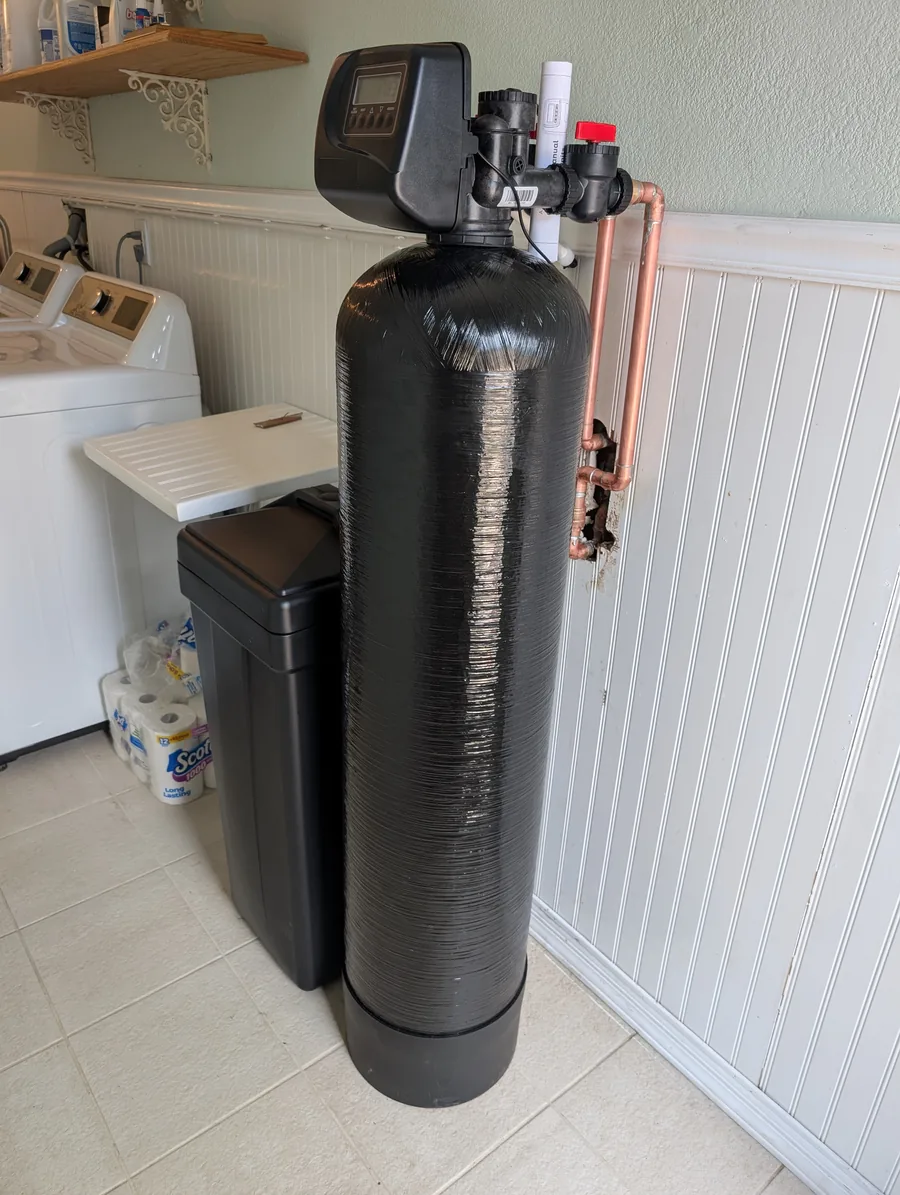
The Tiger Family

The Tiger packages — softener + carbon in one tank, three sizes

The Tigers are the one-tank answer: one tank softens the water and cuts chlorine taste and smell — no second tank, no second footprint. Neil buys them as the supplier’s mixed-bed softeners, whose sheet shows KDF, carbon and softening resin in layers in one tank on a Clack WS1 valve (the Tiger 48’s invoice lists the resin and GAC carbon only). Three sizes, flat-priced, sized to your household and your measured hardness.

Tiger 32 · 32,000 grain

For 1–2 people

Couples, smaller households, or moderate hardness. A 10×54 tank with a bottom distributor plate. The supplier rates its 10×54 softeners that share the tank with carbon at 18,000–24,000 grains at the lower salt setting.

Full spec sheet$2,235Reference price · on your existing loop

Tiger 48 · 48,000 grain

For 3–4 people, or 1–2 on harder water

A 12×52 tank of 8% resin and granular activated carbon (GAC), on a Clack WS1 valve with a 15×17 salt tank. The GAC cuts chlorine taste and smell; the supplier says ordinary carbon does not remove chloramine.

Full spec sheet$2,590Reference price · on your existing loop

Tiger 64K · 64,000 grain

For bigger households and harder wells

The largest Tiger: a 13×54 tank. The supplier rates its 13×54 softeners that share the tank with carbon at 10 GPM of steady flow.

Full spec sheet$3,399Reference price · on your existing loop

Every Tiger comes with two bags of salt. The supplier’s limited warranty: 10 years on the mineral tank, 5 on the valve and the salt tank, 1 on the resin, carbon and parts inside. The plain softener without the carbon is The Bobcat, at $1,799, in the same range of sizes — its spec sheet.

Which size is yours? Grain capacity should match your household and your tested hardness — oversizing wastes money, undersizing wastes salt. The supplier’s sizing worksheet adds the people in the house to the water-using appliances, multiplies by 75 gallons a day, then by your hardness in grains per gallon: that is the hardness removed each day. The free water check (hardness, chlorine and dissolved minerals) with your estimate answers it in five minutes, and the flat price you see for the package is the flat price you pay. As a rough guide (this table sizes up for a margin, so the supplier’s worksheet can give a smaller size; your estimate uses the worksheet and your tested hardness):

Softener size by household and water hardness
Your homeSize that usually fitsTiger package
1–2 people, water up to about 10 gpg (Prescott city water is 4.3–7.6)32,000 grainTiger 32, $2,235
1–2 people at 10–20 gpg, or 3–4 people up to about 20 gpg48,000 grainTiger 48, $2,590
5 or more people, or water over 20 gpg64,000 grainTiger 64K, $3,399

Chloramine is the exception to “carbon takes it out”: the supplier says regular carbon cannot remove it and catalytic carbon can reduce it. The Tiger 48 is invoiced with GAC, so if your utility uses chloramine, ask about the Lynx, which uses catalytic carbon. Compare every package side by side.

Install day

What a typical install day looks like

A typical residential water softener installation in Prescott takes 2 to 4 hours from arrival to system test. Here’s the sequence:

  • 0:00 — Arrival & walkthrough. Neil confirms placement, the water shut-off, drain access and where the salt tank goes.
  • 0:15 — Plumbing tie-in. If the loop is pre-plumbed, the softener connects with shutoff and bypass valves. If not, new lines are run in copper or PEX.
  • 1:30 — Drain line and overflow. The brine drain runs to your laundry standpipe or a floor drain — never to the yard.
  • 2:00 — First regeneration. Bypass closed, system flushed and salt-loaded. Hardness is tested before and after the softener.
  • 3:00 — Walkthrough & warranty. You see the test results, get a maintenance schedule, and sign off.

If you’re also adding under-sink reverse osmosis or arsenic removal: for the RO, plan an extra 1–2 hours; arsenic removal’s install time is on its estimate.

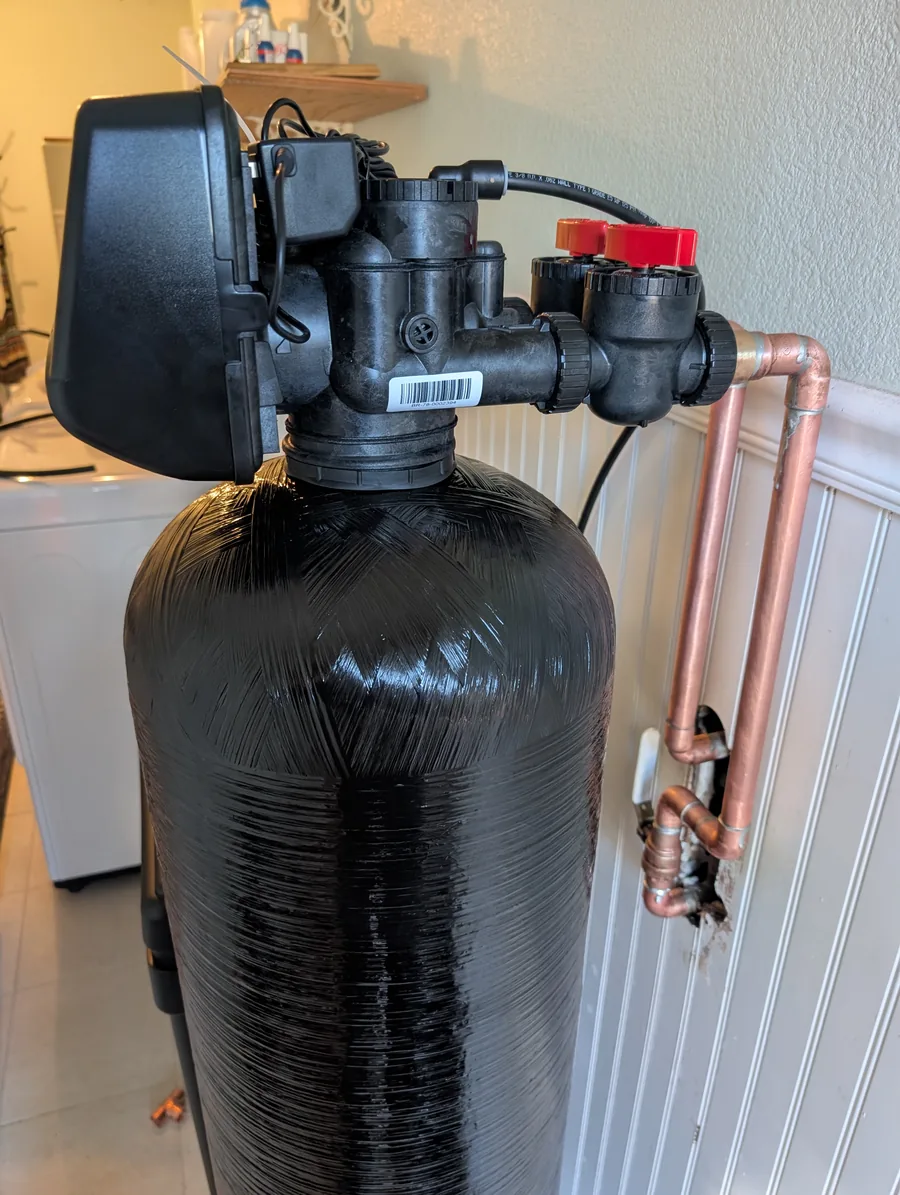
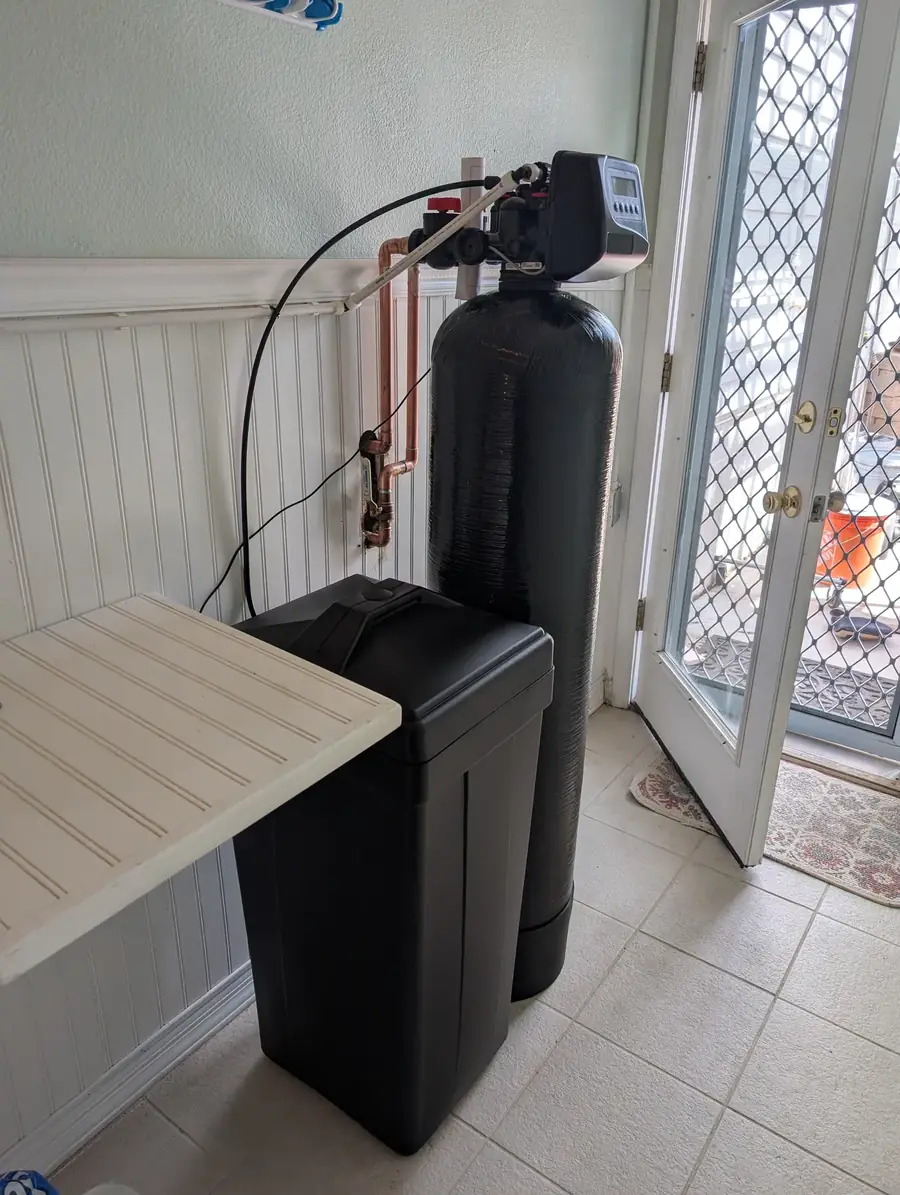
What it looks like when Neil leaves — photographed on the job, not stock images.

Where

Service areas

Once its contractor licenses are issued, CreekWell will install water softeners across all of Yavapai County, including Prescott, Prescott Valley, Chino Valley, Dewey-Humboldt, Sedona, Cottonwood, Camp Verde, Cornville and the rest of the Verde Valley, Mayer, Paulden and the outer county — at the same flat rate in every one. See the complete service-area map.

Related water treatment: whole-house water treatment, whole-house water filters, reverse osmosis, arsenic removal, PFAS removal and private well water treatment.

Want it to look as good as it works?

Any Aqua Cat Series system can wear a custom tank cover — an in-stock Cat Series design, or one made from your own artwork. Removable, and built for Arizona garages.

Questions

Questions people ask Neil

Can you come out right now?

Yes, for repairs and emergencies under $1,000.

Call or text 928-228-5770, Monday to Saturday, 7am to 7pm; a priority call gets a same-day visit when Neil is free. Whole-house systems wait for the contractor licenses (what the licenses change).

How much does water softener installation cost in Prescott?

From $1,799 installed on an existing loop; the Tiger 64K (a softener with a carbon layer in one tank) is $3,399. These are reference prices, not bookable until CreekWell’s contractor licenses are issued.

The Bobcat is one price at every size, 24,000–64,000 grain; the Tigers are priced by size. A home with no softener loop pre-plumbed near the water heater pays for the loop plumbing as its own line, from $179, priced up front, in writing once the licenses are issued. The Tiger 32 is $2,235 and the Tiger 48 $2,590. Every install carries CreekWell’s two-year workmanship warranty plus the supplier’s limited warranty — 10 years on the mineral tank, 5 on the valve and the salt tank, 1 on the media and parts inside.

How big a water softener do I need for my Prescott home?

It depends on how many people live there and how hard your water tests.

One or two people on Prescott city water fit a 32,000-grain Tiger; three or four people, or harder water up to about 20 gpg, a 48,000; five or more people, or water over 20 gpg, a 64,000 — the same rule as the your flat-rate price page. Undersized softeners regenerate too often, wasting salt and water; oversized ones cost more upfront. Neil sizes every install from a measured number — the free hardness check with your estimate, or the $185 lab water test if you are on a well.

How long does a water softener installation take?

Usually 2 to 4 hours.

Homes with a pre-existing loop near the water heater are closer to 2 hours; homes that need new copper or PEX tied in or a drain line added are closer to 4 hours. Installs are scheduled in the morning so the system is fully online before evening water use.

How much salt does a water softener use?

A salt softener for 2 people on Prescott city water uses about 3 to 4 fifty-pound bags a year; for 4 people, about 6 to 8.

That is our arithmetic at 75 gallons a person a day and the supplier’s salt-saving setting; counting a washer and dishwasher the way the supplier’s worksheet does can double it. A 4-person home on a 20-grain well uses about 16 to 21 bags a year — roughly a bag every 3 weeks. Use salt made for water softeners, or potassium chloride, but never the two mixed (the supplier). The supplier sells the Clack WS1 valve with a water meter or on a timer. With a meter it regenerates on the water you actually use, and the supplier says a meter saves water and up to 40% of the salt; which one your softener has is written on your estimate. Each spec sheet works the numbers for its own size.

Salt-based vs. salt-free water softener — which is better in Prescott?

For hard water, salt-based — it is the one that actually takes the hardness out.

A salt-based softener removes calcium and magnesium hardness from your water. It stops the scale that costs a gas water heater efficiency and crusts dishwashers and faucets, and cuts soap and detergent use; softened water is harder on glass-lined tanks, so have the water heater’s anode rod checked on a schedule. Salt-free conditioners are meant to change hardness so it forms less scale, with no scale-reduction certification, and they do not lower the grain count. For water in the 12–30+ gpg range, salt-based is almost always the better long-term choice; on Prescott city water at 4.3–7.6 gpg, salt-free is a reasonable choice if you would rather never carry salt.

Will a water softener work with my existing pipes?

Yes — water softeners install on any common piping.

CreekWell works with copper, PEX, CPVC and galvanized. If your home has very old galvanized lines, Neil inspects them during the walkthrough and flags any sections that should be replaced before softening — galvanized pipes can shed scale once softened water starts dissolving the buildup.

Who installs water softeners near me in Prescott?

Neil Staiger, CreekWell’s owner — the same person who answers the phone and quotes the job.

Once its contractor licenses are issued, CreekWell will install water softeners across Prescott, Prescott Valley, Chino Valley, Dewey-Humboldt, Sedona, Cottonwood and the rest of Yavapai County — no rotating crew and no commissioned salesman. The estimate comes first, and the install is planned for the following week, once your system has been ordered in. Every system is sized from a measured hardness number rather than a guess. If your water also has arsenic, PFAS or a taste problem, ask about pairing the softener with a whole-house filter or an under-sink reverse osmosis system on the same visit — doing both at once saves a second visit.

The list

Join the list for when the licenses are issued

Whole-house systems and other work of $1,000 or more wait until CreekWell’s contractor licenses are issued. Both license applications are with the Arizona Registrar of Contractors. Once the licenses are issued, Neil calls the list in the order it came in. Joining needs no deposit. Repairs under $1,000 that need no permit can be booked now.

Call Neil 928-228-5770 Join the list