Aqua Cat is now CreekWell. Aqua Cat’s old number, 480-228-8282, still reaches Neil. Booking repairs and emergencies under $1,000 now. Whole-house systems wait for the contractor licenses. Request a visit

Well water

Private well water in Yavapai County

Nobody tests your well but you. There is no legal limit on a private well, no annual report, and no utility to call — which makes the first panel the most useful money you will spend on it. CreekWell treats the water and services the pump and tank above ground; we don't drill wells or work down inside them.

Before you call

Well water, yes. Well drilling, no.

Treating well water is one of CreekWell’s specialties, and so is looking after the well equipment you can see. Drilling is not. CreekWell is not a well company and does no work down inside a well, so here is who to call for what.

What CreekWell does

  • Tests. Helps you pick the right certified lab kit, then reads the report with you, free.
  • Treats. Softeners, sediment and iron filters, arsenic removal, UV disinfection and reverse osmosis (the whole-house systems once CreekWell’s contractor licenses are issued).
  • Services the equipment above ground. A jet pump beside the well or in the pump house, the pressure tank, the pressure switch, gauges, valves and the piping you can reach.
  • Disinfects the above-ground side. Shock chlorination of storage tanks, pressure tanks, softeners, brine tanks and filters.

Call a well company for

  • A new well, a deeper well, or casing repair. That takes a licensed well driller.
  • A submersible pump down in the well. Pulling it, replacing it, its wiring or its drop pipe: a licensed pump installer or well company.
  • Shock-chlorinating the well itself. The University of Arizona says to have a licensed well driller or pump installer do it.
  • A problem with a well that was just drilled. The driller who drilled it, first. Here is why.

Which pump do you have?

Go and look at the well. If a pump and motor sit above ground — next to the well, in a pump house or in the garage — it is a jet pump, and that is work we do. If all you see is a well cap with an electrical conduit running into it, the pump is a submersible, down in the water, and that is a job for a pump installer. The National Ground Water Association’s well owner’s guide draws the same line: jet pumps “are mounted above the ground,” and submersibles are “housed underwater down in the well.”

How deep the water is decides which one a well has. A jet pump can only lift water so far: Wayne rates its shallow-well jet pumps for 0 to 25 feet and its convertible jet pumps for 0 to 90 feet, and Goulds’ jet pump manual takes a foot off its 25-foot shallow-well lift for every 1,000 feet above sea level. Deeper than that, the pump has to be a submersible down in the well.

ADWR’s list of licensed well drillers is linked from its Well Drilling in Arizona page, and ADWR or the Registrar of Contractors can tell you whether a driller is licensed and in good standing.

The short list

Why Yavapai County wells need treatment

Yavapai County is one of the most well-dependent parts of Arizona — from Williamson Valley to Cornville, homes rely on private wells with no municipal oversight. The geology is one of the toughest, too. A peer-reviewed analysis of 33,099 Arizona water samples found that 43.6% of Yavapai County samples exceed the EPA’s 10 ppb arsenic limit — the second-highest rate of any Arizona county — and the Arizona Department of Health Services recorded one Cornville-area well at 952 µg/L, 95 times the EPA limit. Measured readings, town by town: arsenic in Yavapai County well water.

Beyond arsenic, a Yavapai County well often runs hard, can carry iron and manganese — the rust and black staining in toilets and laundry — and may contain coliform bacteria, nitrates from septic systems, or radium and uranium from the granite bedrock. Untreated, that water wears out appliances and stains what it touches, and in the case of arsenic and uranium it is a real long-term health risk. None of it is visible until you test.

What Yavapai County wells actually carry

Common contaminants in Yavapai County private wells
WhatReference pointWhy it matters here
ArsenicEPA limit 10 µg/LNaturally occurring in the local geology. Readings far above the limit have been recorded in the county — single wells near Cornville and Paulden have tested at 952 and 3,400 µg/L. No taste, no smell, no color.
Coliform bacteriaShould be zeroA cracked casing or a bad seal is enough. The most important annual test and the cheapest to run.
NitrateEPA limit 10 mg/L, measured as nitrogen (about 44 mg/L if your report gives nitrate “as NO3”)Septic systems and agriculture. Genuinely dangerous for infants under six months.
Iron & manganese0.3 / 0.05 mg/LOrange and black staining on fixtures and laundry. Iron is a nuisance rather than a health risk; manganese can be both (see the FAQ below).
HardnessUSGS: hard above 7 gpgCity systems here report roughly 4–10 gpg. Private wells are untested and vary far more: ADEQ’s study of 58 Prescott-area wells averaged about 12 gpg, with 31 of them hard or very hard. Scale in the water heater is the real cost.
UraniumEPA limit 30 µg/L (30 ppb)Present in some Arizona groundwater. Over the limit, EPA lists an increased risk of cancer and kidney toxicity. Included in the $185 panel.

Reference limits are the U.S. EPA National Primary and Secondary Drinking Water Regulations; the hardness threshold is the U.S. Geological Survey scale. EPA’s nitrate limit is measured as nitrogen; 1 mg/L as nitrogen is 4.43 mg/L as nitrate, so the same limit reads about 44 on a report that uses NO3 (National Research Council, “Nitrate and Nitrite in Drinking Water”). Local readings are re-checked annually against Arizona Department of Environmental Quality and Arizona Department of Health Services publications. Local figures: Jones MC et al., “Arsenic Concentrations in Ground and Surface Waters across Arizona Including Native Lands,” Journal of Contemporary Water Research & Education, 2020 (33,099 samples, 1990–2017); ADHS health consultations for Cornville and Paulden; ADEQ, Ambient Groundwater Quality of the Prescott Active Management Area.

The test

What a complete well water test reveals

The SimpleLab well panel we point customers to — the Drinking Water Test: Level 1 + Bacteria, $185, ordered directly from the lab — screens your well for 53 parameters in a single sample:

  • Health-risk metals: arsenic, lead, uranium, chromium (reported as total chromium, chromium-6 included) and copper.
  • Aesthetic minerals: iron, manganese, hardness (calcium and magnesium) and TDS.
  • Bacteria and nitrates: coliform, E. coli and nitrate-nitrogen.
  • Other: pH, sulfate, fluoride, chloride and sodium.

Results come back in 7–10 days door to door — SimpleLab’s standard is about 5 business days once the lab has the sample, plus the mail both ways — with EPA comparison flags. From there we design a treatment train: usually a sediment pre-filter, a softener for hardness, an arsenic or iron-removal stage if the test demands it, and an under-sink RO for drinking water. No two Yavapai wells are identical, which is why every system here is sized to the numbers on your report.

Order the kit from SimpleLab

Bookable now

What can be booked now

  • Under-sink reverse osmosis: the Kitten, 5-stage, $829, or the Ocelot, 6-stage alkaline, $999 installed. It is a practical answer for arsenic V and nitrate in the water you drink and cook with (not certified; a test of the RO water shows your result). Your well must be inside its limits — arsenic V up to 300 ppb (Charger’s rating), iron up to 0.3 ppm and manganese up to 0.1 ppm — and the job must need no permit. Above those limits, the treatment ahead of it is whole-house work, which waits for the licenses, so the RO waits with it. If a granite, quartz or stainless counter needs a new faucet hole, the Ocelot goes over $1,000 and waits too.
  • The lab test comes first, and you order it: SimpleLab’s $185 panel, 53 parameters, from a sample you take at the wellhead or the tap. SimpleLab bills you at its price; Neil reads the report with you afterwards, free.
  • Service and repair on what you already have. Cartridge changes, sanitizing, leaks, pressure problems, fixtures.
  • Pump and pressure-tank service, above ground. A jet pump beside the well or in the pump house, the pressure tank, pressure switch, gauge and valves — quoted flat before any work starts. A submersible pump down in the well is a pump installer’s job; see who to call.
  • Shock chlorination above ground. Storage tanks, pressure tanks, softeners, brine tanks and filters, when bacteria shows up on the house side — tested before and after. The well itself goes to a well driller or pump installer.
  • A plain-English read of the report. Including telling you when the answer is that your well is fine.

Whole-house well packages — sediment, iron removal, softening and disinfection as one designed system — are priced below and on the pricing page for planning.

New wells

Just had a well drilled? Call the driller first.

Arizona puts the first disinfection of a new drinking-water well on the driller. The state rule says a well drilling contractor “shall disinfect” the well “before removing the drill rig from the well site” (A.A.C. R12-15-814), and ADWR’s guide for new-well owners says it plainly: “Make sure your driller properly develops and disinfects your well.” The University of Arizona adds that the driller should then sample the well for coliform bacteria before the rig leaves, so ask for that result. Once the pump goes in, the University of Arizona’s well owner’s toolkit puts the next shock chlorination on the pump installer, who may not be the driller.

New well tastes or smells like fuel or oil?

  • Stop drinking it, and don’t cook with it. Use bottled water until a lab says otherwise. Wisconsin’s natural resources department puts it bluntly: “If you can smell gasoline, it is probably present above any health standards.”
  • Call the driller, and whoever put the pump in. Arizona bans petroleum-based drilling fluids and requires the driller to remove everything put into the well while building it (A.A.C. R12-15-811(F)). The University of Arizona adds that pump work can bring oil and grease into a well, and recommends purging the well right afterwards.
  • It may be bacteria, not fuel. The Minnesota Department of Health lists “swampy, oily or petroleum” among the smells iron bacteria cause, along with a “rainbow colored, oil-like sheen,” and notes that “drilling, repair, or service work can also introduce iron bacteria into a well.” The Minnesota Department of Health adds that iron bacteria are not known to cause disease, but they can create conditions where germs that do can grow. The usual fix is shock chlorination by the well contractor, and it can take more than one round.
  • Test before anything else. A lab test is the only way to tell fuel from bacteria. When water smells of gasoline or fuel oil, EPA says to test for volatile organic compounds (VOCs). SimpleLab’s VOC Water Test, $139, checks 60 of them, including benzene, toluene, ethylbenzene, xylenes and MTBE. Level 2 + Bacteria, $284, checks the same fuel compounds and adds arsenic, uranium, nitrate and coliform bacteria. For iron bacteria, SimpleLab’s Biofilm Bacteria Water Test, $321, checks iron-related, slime-forming and sulfate-reducing bacteria. All three are on the order list. The University of Arizona also suggests a total petroleum hydrocarbons (TPH) test, which SimpleLab does not sell; ask your driller which lab they use.
  • Shock chlorination fixes bacteria, not fuel. CDC: “Water contaminated with fuel or toxic chemicals will not be made safe by boiling or disinfection.” And the University of Arizona warns that heavy chlorination can dissolve arsenic out of the rock around a well, so test again afterwards — arsenic is the one to watch in Yavapai County.
  • Check for a leaking fuel tank nearby. ADEQ keeps a map of leaking underground storage tanks and encourages anyone with a private well near one to test the water.
  • If the driller won’t make it right, call ADWR’s Groundwater Permitting and Wells Unit at 602-771-8527, or use ADWR’s online complaint form. ADWR does not take anonymous complaints.

Once the source is fixed and the results are in, CreekWell can help with treatment if the water still needs it. The driller comes first, and so does the test.

Hardness

Hard water in your well? We’ll make it soft.

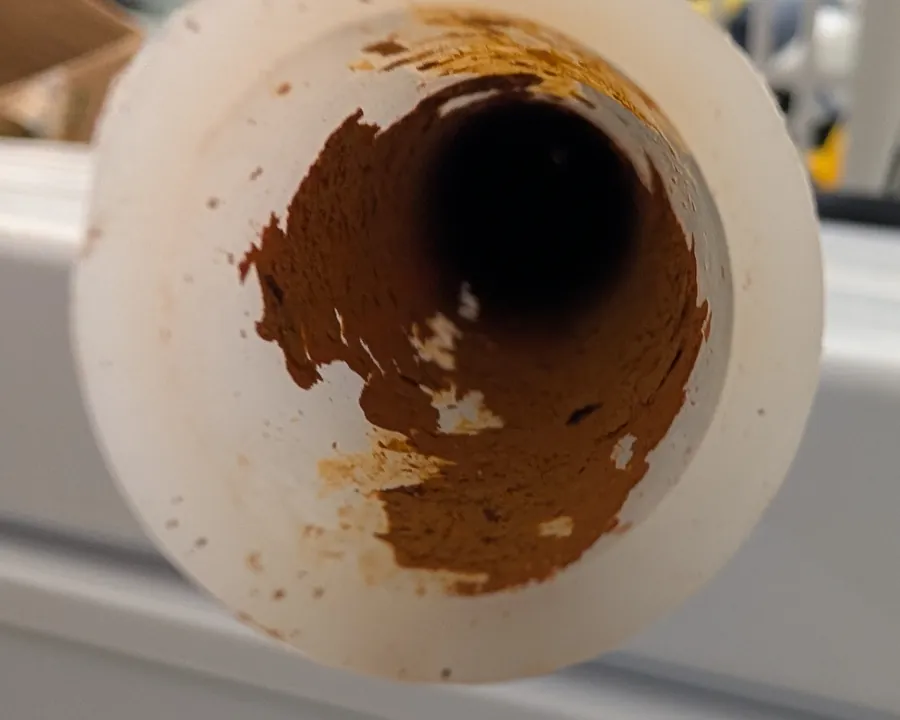
More than half the wells up here run hard. You can feel it — dry, itchy skin after a shower, white spots on the glasses, stiff towels, crusty faucets, and appliances wearing out years too early. That chalky stuff is hardness, and a softener takes it out.

What you’ll notice

  • Softer skin and hair — soap and shampoo rinse all the way off.
  • Spotless dishes — no more white film on the glasses.
  • Softer laundry, less soap — towels stay fluffy, colors last, and you use less detergent.
  • Less scrubbing — no soap-scum rings or crusty shower heads.
  • Less scale in appliances — softening takes out the hardness that forms scale in the water heater and washer.

For a well whose main problem is hardness, the Bobcat Package softens it; the Tiger 48 Package softens it and adds a carbon layer for taste and smell in the same tank.

Our honest promise

A softener fixes hard water — that’s it. It is not a drinking-water filter, and we won’t pretend it is. We check your hardness, chlorine and TDS on the meter first, free, while we’re there for the estimate. If all you’ve got is hard water, that’s all we fix. Want cleaner drinking water too? We’ll add a small under-sink filter — only if you actually need it.

Already own the equipment?

Once CreekWell’s contractor licenses are issued, we will install it for $999 flat: on your existing softener loop, or on a new connection within 10 feet of the main water shutoff in the garage. That is a standard indoor hookup — no digging, trenching or underground work. A longer run is priced up front, in writing once the licenses are issued; hauling the old unit away is not included. More on installing equipment you bought.

The hardest well water Neil has treated

Packages

Common well treatment systems

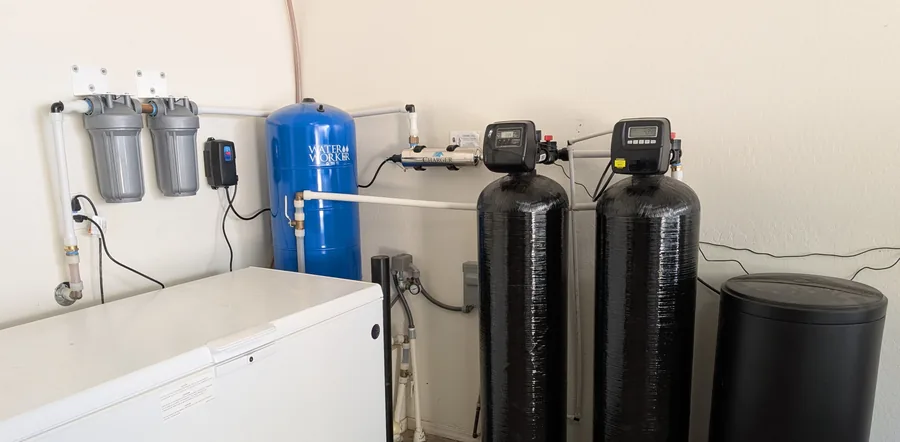
For most Yavapai County wells we recommend a treatment train of up to four stages, sized to your test results:

  1. A sediment pre-filter, which protects everything after it from sand and silt.
  2. Iron and manganese removal (oxidizing media or air injection), for the rust and black staining.
  3. A whole-house softener, for hardness.
  4. An arsenic stage for the whole house, or under-sink RO for drinking and cooking water.

The under-sink RO, the Kitten ($829) or the Ocelot ($999), can be booked now if your water is inside its limits (iron up to 0.3 ppm, manganese up to 0.1 ppm and arsenic V up to 300 ppb) and the job needs no permit. If a granite, quartz or stainless counter needs a new faucet hole, the Ocelot goes over $1,000 and waits for the licenses.

If your test shows only hardness, the softener is all you need; if it shows iron or arsenic, we add only that stage — never a system your water doesn’t need. If it shows coliform or E. coli, the source is found and fixed first and the water is tested again; UV (not NSF/ANSI 55 certified) is only a barrier for water that then tests clean.

Not bookable yet. This work comes to $1,000 or more, so it waits for CreekWell’s contractor licenses.

Why not yet?

Until its Arizona contractor licenses are issued, CreekWell takes only jobs that come to under $1,000 in all and need no permit and no gas. The price is published so you can plan and compare; it is not an offer, a quote or a bid. What the licenses change

Tiger 48 package — 48K mixed-bed softener + carbon

One tank that softens and cuts chlorine taste and smell, for 3–4 people, or 1–2 on harder water up to about 20 grains. A 48,000-grain, 12×52 tank of 8% resin and GAC carbon on a Clack WS1 valve (metered or timer: written on your estimate), salt-regenerated, with a 15×17 salt tank. Sized to your household and hardness.

Full spec sheet$2,590Reference price

The Bobcat package

A whole-house softener on its own, sized to your home from 24,000 to 64,000 grain — for a well whose only problem is hardness.

Full spec sheet$1,799Reference price

The Sand Cat package

Sediment filter plus softener: clears the grit and softens the hard water. A sediment pre-filter on its own is priced at the free check.

Full spec sheet$3,075Reference price

The Panther package

Iron and sulfur filter plus softener, for wells with rusty stains or a rotten-egg smell. Your well has to supply the filter’s backwash flow.

Full spec sheet$3,400Reference price

The Serval package

Whole-house ultraviolet disinfection. It disinfects well water with UV light, adding no taste or odor, and goes last, after any filters. It is for a well that tests safe today: it is not NSF/ANSI 55 certified, and Ohio’s health department says water with harmful germs in it calls for a certified Class A unit. Needs clear water, an always-on outlet and a lamp every year.

Full spec sheet$1,875Reference price

The Jaguar package

Whole-house arsenic removal: an AdEdge Medallion (POE-7-1354 or POE-10-1465, by your flow) with Bayoxide E33 media, suited to your water by a lab test. Treated-water lab tests follow for as long as you own it.

Full spec sheet$4,750Reference price

The Cougar package — the complete well system

Sediment filter, iron filter, softener and UV disinfection, designed as one system for a well with grit, iron or sulfur and hardness, with UV as a barrier on water that tests safe today: $6,475 installed (a reference price), sized from your lab test. If a test has found coliform or E. coli, the source is found and fixed first; its UV is not NSF/ANSI 55 certified. Full spec sheet.

Every package includes the plumbing, installation and testing, with the two-year workmanship warranty plus the maker’s or the supplier’s warranty on the parts (AdEdge publishes none for the Medallion). The supplier’s softener warranty is 10 years on the mineral tank, 5 on the valve and the salt tank, and 1 on the media and parts inside. Compare every package side by side.

Where we work

Service areas for private well treatment

CreekWell works on private wells across all of Yavapai County, including Prescott, Prescott Valley, Chino Valley, Williamson Valley, Spring Valley, Dewey-Humboldt, Mayer, Paulden, Sedona, Cottonwood, Camp Verde, Cornville, Rimrock, Lake Montezuma, Jerome and Clarkdale.

Rural roads are fine

Williamson Valley, Skull Valley, Kirkland, Paulden, Walker, Groom Creek, out past Cornville — the well is usually a long way from the pavement, and that is normal here. There is no trip fee anywhere in Yavapai County, and no surcharge for a dirt road.

Same flat rate across the whole service area. These prices apply everywhere in Yavapai County — Prescott, Prescott Valley, Chino Valley, Dewey-Humboldt, Mayer, Paulden, Sedona, Cottonwood, the Verde Valley and the outer county. It is not a Prescott-only rate.

Related: arsenic removal · PFAS removal · whole-home reverse osmosis · water testing

Questions

Questions people ask Neil

Can you come out right now?

Yes, for repairs and emergencies under $1,000.

Call or text 928-228-5770, Monday to Saturday, 7am to 7pm; a priority call gets a same-day visit when Neil is free. Whole-house systems wait for the contractor licenses (what the licenses change).

Do you drill wells or work on well pumps?

Neil does not drill wells or work down inside them.

We do service the pump and pressure tank when they sit above ground.

That means a jet pump beside the well or in the pump house, the pressure tank, the pressure switch, gauges, valves and the piping you can reach — and treating the water, which is one of our specialties. A new or deeper well, casing repair, or a submersible pump down in the well is a job for a licensed well driller or pump installer. ADWR’s list of licensed drillers is linked from its Well Drilling in Arizona page. How to tell which pump you have.

Do you test private well water in Yavapai County?

Yes — through a certified lab, not a meter: SimpleLab’s 53-parameter panel, $185, which you order direct and we read with you free.

Wells here carry arsenic, iron, manganese, nitrate and bacteria in combinations that change from one property to the next. The EPA limit for arsenic is 10 micrograms per liter and some county wells exceed it substantially. Nobody can tell you what is in your well without testing it, and a handheld meter cannot measure arsenic at all.

How often should I test my private well in Yavapai County?

Every year at minimum — and in Yavapai County, make arsenic part of that yearly test.

EPA and CDC advise testing a private well at least once a year for bacteria, nitrates, total dissolved solids and pH. Here, add arsenic and a basic mineral panel, and test again any time you notice a taste, color or odor change, or after well-pump service. A peer-reviewed analysis of 33,099 Arizona samples found 43.6% of Yavapai County samples above the EPA arsenic limit (Jones et al., 2020), and contamination can develop over time as the water table drops. For a brand-new well, the Arizona Department of Health Services recommends testing for arsenic, fluoride, lead, nitrates, total coliform bacteria, total dissolved solids and uranium, then coliform and nitrates every year and arsenic, fluoride and uranium every five years (as ADWR passes it on). The $185 panel covers all seven.

My well was tested when I bought the house. Is that enough?

No, unless that was within the last year for bacteria and arsenic, and three years for the rest of the chemistry.

A well is a hole in the ground with a seal and a pump, and all three age. Test after any work on the well, after heavy monsoon runoff, and whenever taste, smell or color changes.

Is well water in Prescott safe to drink without treatment?

Not without testing. Many Yavapai County wells are perfectly safe; many are not.

Arsenic, uranium and bacteria are colorless, odorless and tasteless — you cannot tell by looking. The $185 SimpleLab panel we recommend screens for arsenic, lead, uranium, coliform bacteria, nitrates, hardness, iron and more in a single sample. You order it directly from the lab. Test before you assume.

Do I need a water softener if I have a private well?

Often — but measure it first.

ADEQ’s study of 58 wells across the Prescott Active Management Area found 31 hard or very hard, averaging about 12 grains per gallon — well above the U.S. Geological Survey’s 7 gpg “hard” line — but 27 were soft or only moderately hard. Hard well water leaves scale on fixtures and in appliances, and it costs a gas water heater efficiency (in the tests Pacific Northwest National Laboratory reviewed, the effect on electric tanks was negligible). The free check at your estimate reads your hardness in a few minutes, and the next question covers whether a softener pays for itself.

Is it worth treating a well that only has hardness?

That depends on your water heater, not your water.

At the 4 to 10 grains per gallon the local utilities report — or the 12 or so ADEQ found on an average Prescott-area well — scale costs a gas water heater efficiency; in the tests Pacific Northwest National Laboratory reviewed, the effect on electric tank heaters was negligible. Whether that justifies a softener is a straightforward arithmetic question about what those appliances cost, and it is a conversation worth having before you spend anything.

Is iron or manganese in well water harmful?

Iron is a nuisance, not a health risk; manganese can be both.

EPA’s guidelines for them — 0.3 mg/L (0.3 ppm) of iron and 0.05 mg/L (0.05 ppm) of manganese — are secondary standards for taste, color and staining, and EPA says these are not considered a risk to health at those levels. Manganese also has health guidance: the Minnesota Department of Health says a safe level is 100 micrograms per liter (0.1 ppm) or less for babies who drink tap water or formula made with it, and 300 (0.3 ppm) or less for everyone else, because long-term high levels may affect memory, attention and motor skills. SimpleLab’s $185 panel measures both, and Neil reads it with you, free.

Can a water softener remove iron from well water?

Small amounts — up to about 2 ppm of dissolved (ferrous) iron.

Above that, iron fouls the resin and shortens softener life dramatically, so a Yavapai County well with more than 2 ppm needs a dedicated iron-removal stage ahead of the softener — which is what the Panther Package pairs. The lab panel reports your iron, and we size from that number.

How is bacteria treated in well water?

Test for coliform first.

If it is found, the source is found and fixed, then the water is tested again; until a retest is clean, do not drink it: use bottled water or another safe source (CDC; the next question has the details).

  • Above ground: CreekWell shock-chlorinates storage tanks, pressure tanks, softeners, brine tanks and filters. The University of Arizona’s well owner’s toolkit notes that water heaters, softeners, filters and pressure tanks may need disinfecting along with the well.
  • The well itself: the same toolkit says to have a licensed water well driller or pump installer shock it, and warns that chlorine can dissolve arsenic out of the aquifer, so test again afterwards.
  • A new well: it should already have been disinfected by its driller before the rig left (A.A.C. R12-15-814).
  • Once the water tests clean: an ultraviolet unit leaves no taste or odor and runs whenever water flows — the Serval Package, $1,875 installed, a reference price until the contractor licenses are issued. Its UV is not certified to NSF/ANSI 55 Class A, the grade Ohio’s health department says water with harmful germs in it calls for, so it is a barrier for safe water, not a fix for a contaminated well.
  • Timed chlorine: the other option for ongoing protection. The toolkit says continuous chlorination should be professionally sized, because it usually needs a holding tank for contact time and a booster pump, and that chlorinated water should be tested for disinfection byproducts, with a carbon filter after it if needed.

Your local health or environmental department can help you understand the results.

My well tested positive for coliform. What do I do until it is fixed?

Do not drink it: until the source is found and fixed and a retest is clean, use bottled water or another safe source (CDC).

CDC says boiling kills germs in water, and for a well with germs in it points to its boil-water advisory guidance (CDC):

  • Drinking and cooking: bottled water, or water brought to a full rolling boil for 1 minute (3 minutes above 6,500 feet) and cooled. Boiling does not remove chemicals: it leaves arsenic in and concentrates nitrate.
  • Brushing teeth, ice and baby formula: boiled or bottled water; ready-to-use formula if possible.
  • Bathing and showering: be careful not to swallow any water; a sponge bath for babies and young children.
  • Dishes: a dishwasher with a sanitizing cycle, or a final rinse of at least 150°F; by hand, wash and rinse in hot water, then soak the dishes for a minute in a weak bleach solution (CDC’s page gives the mix).
  • Laundry and handwashing: laundry as usual; in many cases, tap water and soap for hands.
  • Pets: bottled water, or boiled water that has cooled.

Then the source is found and fixed, as above, and the water tested again. Your local health department can help you read the results, and Neil reads them with you, free.

Is it safe to shower or wash dishes if nitrate is over 10 mg/L?

Yes — nitrate is a concern for drinking and food, not for bathing, showering or washing.

EPA says nitrate “is only a concern for ingestion (eating and drinking). It is not absorbed through your skin.” The Oregon Health Authority spells out the rest for water over 10 mg/L:

  • Bathing, swimming and showering: safe as long as you avoid swallowing the water. Supervise children under six months old when they are bathing or brushing teeth, so they do not swallow it.
  • Dishes, clothing, bedding and linens: the water can be used to wash them.
  • Drinking, food and baby formula: EPA says not to mix well water containing more than 10 mg/L of nitrate with infant formula or food, and the Oregon Health Authority says not to use it to wash, prepare or cook food for infants under six months old. Boiling does not remove nitrate and can raise it.
  • Animals: nitrate affects young animals the way it affects human infants, and they should not drink water with more than 10 mg/L of it.

EPA’s 10 mg/L limit is measured as nitrogen; the table above gives the figure for a report that uses NO3. The CDC says reverse osmosis can reduce nitrate, and the $185 panel measures it; Neil reads it with you, free.

My new well’s water tastes like fuel or oil. Can you shock-chlorinate it?

Not the well itself — that is the driller’s job.

Stop drinking the water, call your driller, and have it tested: the smell could be fuel or iron bacteria.

Arizona makes the driller disinfect a new drinking-water well before the rig leaves (A.A.C. R12-15-814), bans petroleum-based drilling fluids, and requires the driller to remove everything put into the well during construction (A.A.C. R12-15-811(F)). CDC says water contaminated with fuel “will not be made safe by boiling or disinfection.” An oily or petroleum smell can also come from iron bacteria, which drilling can introduce (Minnesota Department of Health); shock chlorination by the driller is the usual fix for those, though the University of Arizona warns it can dissolve arsenic from the rock around a well, so test again afterwards. A VOC test tells fuel from bacteria — SimpleLab’s VOC Water Test is $139 — and see what to do about a new well.

What does a complete well water treatment system cost?

From $1,799 for hardness alone to $6,475 for the complete package; arsenic treatment adds $4,750.

Every price is a flat rate from the countywide book, and the configuration depends on what your water test shows: a hardness-only well starts at $1,799 (the Bobcat Package), or $2,590 for the Tiger 48 softener with carbon; sediment or iron packages with a softener run $3,075–$3,400 (the Sand Cat Package, the Panther Package); the complete package — sediment, iron, softener and UV — is $6,475 flat (the Cougar Package); and arsenic treatment adds $4,750 (the Jaguar Package). Every system is sized from your lab results, not from a generic package list. The whole-house systems are reference prices until the contractor licenses are issued.

Book now

Call Neil, or request a visit

Monday to Saturday, 7am to 7pm. Neil answers his own phone and calls requests back in the order they came in.

Call Neil 928-228-5770 Request a visit